TL;DR · The five things to know
- 01The solution works today
xECM + OpenText Search + Content Aviator (CSAI) on Azure OpenAI is operational and validated end-to-end. This is not a support case.
- 02We need architectural confirmation, not bug fixes
We have read the official documentation and built an interpretation. We need OpenText to confirm or correct it before further investments.
- 03Three product areas are unclear to us
AMS (Aviator Model Services), Cloud Bridge and Content Aviator SaaS — how they fit together and which is the recommended enterprise path.
- 04We need the recommended target architecture
Out of Models A–E, which one does OpenText recommend for an enterprise with strict data residency and on-prem xECM?
- 05We need the right OpenText counterparts
Product Management, Solution Architecture and Product Specialists — not first-line support. The output is a documented validation, not a ticket.
This is not a support request. This is not an installation issue. The current solution is operational and validated. This package is an architecture review and strategic validation request directed at OpenText Product Management, Solution Architecture and Product Specialists.
Boliden – OpenText Content Aviator
Architecture Review & Strategic Validation
A package for OpenText Product Management, Solution Architecture and Product Specialists. The goal is to validate architectural understanding, clarify product positioning, confirm the recommended target architecture and route discussions to the correct OpenText teams.
Verified Environment
Verified- xECM
- OpenText Search
- Content Aviator / CSAI
- Azure OpenAI
- pgvector
Not Implemented
Requires OpenText Validation- AMS
- Cloud Bridge
- Content Aviator SaaS
Primary Objective
Current Understanding- Validate architecture understanding
- Clarify deployment models
- Identify target architecture
- Connect with correct OpenText experts
Executive Summary
Swedwise has successfully implemented and validated OpenText Content Aviator integrated with OpenText Content Management using Azure OpenAI. The environment is operational and exercised end-to-end.
As part of this review we have studied the official Content Aviator, Content Management, Search, and Aviator Model Services administration guides, as well as the public Content Aviator SaaS material.
The purpose of this package is to validate our understanding of the product architecture and identify the recommended production architecture together with OpenText.
- · Content Aviator Installation & Admin Guide
- · Content Aviator Administration Guide
- · Search Administration Guide (§ 1.1.5)
- · Aviator Model Services Installation & Admin Guide
- · Public Content Aviator SaaS materials
Decision Required from OpenText
Architecture Strategy
- What is OpenText's recommended enterprise architecture for Content Aviator?
- Is CSAI → Azure OpenAI considered a first-class production architecture?
- When should customers adopt AMS?
Product Positioning
- How should AMS, Cloud Bridge and Content Aviator SaaS be positioned relative to one another?
- Are these complementary deployment models or alternative paths?
- What is the preferred architecture for enterprise customers?
Future Direction
- What is the long-term direction for AMS?
- What is the long-term direction for Cloud Bridge?
- What is the long-term direction for Content Aviator SaaS?
- Which architecture aligns best with OpenText's future AI strategy?
Expected Outcome from this Review
Validate
Confirm or correct our architectural understanding of CSAI, AMS, Cloud Bridge and SaaS.
Clarify
Answer open architecture questions and product-positioning questions.
Recommend
Recommend the target architecture for Boliden's enterprise Content Aviator deployment.
Connect
Identify the appropriate OpenText Product Managers, Architects and Specialists to engage.
Current Verified Implementation
The current CSAI → Azure OpenAI architecture has been successfully implemented, tested and validated. This environment is operational. It is not a proof of concept. This review is focused on architecture and strategy, not on installation support.
- xECM
- Business Workspaces
- Metadata
- Categories
- Search runtime
- Vector data source
- chat-svc
- embed-svc
- embed-wrkr
- RabbitMQ
- pgvector
- aviator-studio
- Azure OpenAI
- Azure Embeddings
Current Configuration — extracted from CSAI deployment values
VerifiedSource: live values from the CSAI Helm/deployment configuration in our environment (chat-svc / embed-svc / embed-wrkr). Not from xECM or Azure portal.
CONTENT_SYSTEM: otcm

LLM: azure
MODEL_NAME: gpt-5-nano

EMBEDDINGS: azure
EMBEDDINGS_MODEL: text-embedding-3-small

VECTOR_STORE: pgvector

AZURE_OPENAI_API_VERSION: "2024-10-21"
Documentation Reviewed
OpenText Content Aviator Installation and Administration Guide
- · Installation
- · Runtime understanding
Content Aviator Administration Guide
- · Configuration
- · Administration
Search Administration Guide — § 1.1.5 Creating a Content Aviator Data Source
- · Vector indexing understanding
Aviator Model Services Installation and Administration Guide
- · AMS architecture
- · Deployment model
- · Supported models
- · API understanding
Public OpenText Content Aviator Materials
- · SaaS understanding
- · Cloud understanding
- · Product positioning
Why We Are Engaging OpenText
Swedwise has reviewed the official documentation and public material covering Content Aviator, Content Management, Search Administration, Aviator Model Services (AMS) and the public Content Aviator SaaS information.
On that basis we have formed an architectural understanding of how the products fit together and how a Content Aviator deployment is intended to operate at enterprise scale.
We now require OpenText validation to ensure that our interpretation is correct. The goal is to avoid architectural assumptions and to align future investments with OpenText's strategic direction.
- · Content Aviator documentation
- · Content Management documentation
- · Search Administration documentation
- · AMS documentation
- · Public Content Aviator SaaS information
Executive Architecture Overview
Users
- End users
- Business users
OpenText Content Management
- xECM
- Business Workspaces
- Metadata
- Categories
- Security Clearance
- Permissions
OpenText Search
- JSON Activator
- Vector Document Conversion
- Vector Extractor
CSAI
- chat-svc
- embed-svc
- embed-wrkr
- RabbitMQ
- pgvector
- aviator-studio
Current Verified Path · Azure OpenAI
- Azure OpenAI
- GPT-5 Nano
- text-embedding-3-small
Alternative Path · OpenText Aviator Model Services
- APISIX Gateway
- Content Safety
- Authentication
- Routing & Guardrails
- Model Management
- OpenAI-compatible APIs
- vLLM — Llama, Gemma, Snowflake Arctic, Whisper, CLIP
Cloud Bridge & SaaS
- Cloud Bridge
- OpenText Managed Cloud
- Content Aviator SaaS
System Map · Current Architecture & Options
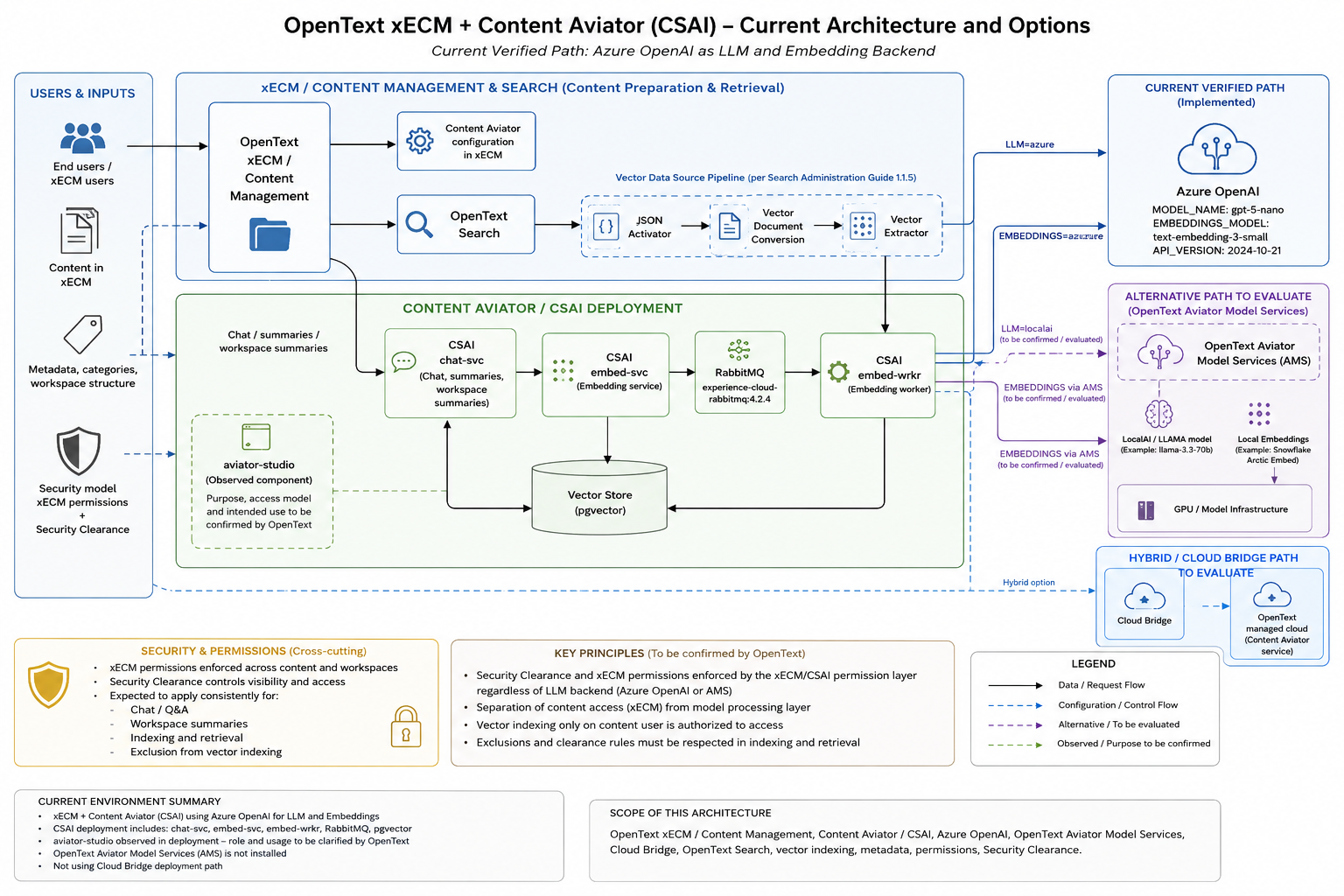
Full architecture map covering xECM content preparation, OpenText Search vector pipeline, CSAI runtime (chat-svc, embed-svc, embed-wrkr, RabbitMQ, pgvector, aviator-studio), current verified Azure OpenAI path, alternative AMS path, hybrid Cloud Bridge / SaaS path, and cross-cutting Security Clearance and xECM permissions.
Content Preparation Pipeline
CSAI Runtime Architecture
Chat Path
Verified- 1.chat-svc
- 2.Retrieval
- 3.Azure OpenAI
- 4.Response
Embedding Path
Verified- 1.embed-svc
- 2.RabbitMQ queue
- 3.embed-wrkr
- 4.Azure Embeddings
Vector Path
Verified- 1.embed-wrkr
- 2.pgvector store
- 3.chat-svc retrieval
Current Understanding of AMS
AMS appears to function as an Enterprise AI Gateway and Model Platform, providing a unified entry point to local and managed models with policy, safety and OpenAI-compatible APIs.
- etcd
- APISIX Control Plane
- APISIX Data Plane
- Content Safety Service
- vLLM
- Llama
- Gemma
- Snowflake Arctic Embed
- Whisper
- CLIP
- /v1/chat/completions
- /v1/embeddings
- /v1/models
- /v1/rerank
- /v1/audio/transcriptions
Deployment Models
Direct Azure OpenAI
AMS + Local Models
AMS + Cloud Models
Cloud Bridge
Content Aviator SaaS
Facts vs Understanding vs Open Questions
Facts
Verified- Azure OpenAI works
- CSAI deployed
- Search operational
Understanding
Current Understanding- AMS as AI Gateway
- Vector indexing interpretation
- CSAI interaction model
Open Questions
Requires OpenText Validation- Cloud Bridge role
- SaaS relationship
- Security Clearance enforcement
- aviator-studio purpose
Security and Permission Model
Entire section requires OpenText validation
Requires OpenText ValidationRequested OpenText Participation
| Topic | Requested Role | Why |
|---|---|---|
| Content Aviator Architecture | Product Management | Architecture validation |
| AMS Architecture | Product Management | Product positioning |
| AMS Deployment | Product Specialist | Technical review |
| Search & Vector Indexing | Search Specialist | Validate indexing flow |
| Security Clearance | Security Specialist | Validate enforcement model |
| Cloud Bridge | Product Management | Clarify architecture |
| Content Aviator SaaS | Product Management | Clarify service model |
| Roadmap | Product Management | Strategic guidance |
| aviator-studio | Product Specialist | Explain component role |
Open Questions
Strategic Questions· Requires Product Management
Requires OpenText Validation- Q1Is AMS OpenText's strategic AI platform?
- Q2Is AMS needed to enable usage of metadata from Categories and other system data?
- Q3Is Azure OpenAI a fully supported enterprise architecture?
- Q4What is OpenText's recommended architecture for new customers?
- Q5How should customers choose between Azure OpenAI, AMS, Cloud Bridge and SaaS?
Architecture Questions
Requires OpenText Validation- Q1Is the Verified Path (CSAI → Azure OpenAI) a supported production pattern?
- Q2Is AMS the recommended path for enterprises with multi-model needs?
- Q3How do CSAI components interact in detail (chat-svc, embed-svc, embed-wrkr, RabbitMQ, pgvector)?
- Q4What is the intended purpose of aviator-studio? Is it only connected to AMS?
AMS Questions
Requires OpenText Validation- Q1Is AMS positioned as an Enterprise AI Gateway or a Model Hosting platform?
- Q2Which models are officially supported and validated by OpenText?
- Q3What hardware/footprint is required for AMS in production?
- Q4Can AMS proxy Azure OpenAI alongside local vLLM models?
Security Questions
Requires OpenText Validation- Q1How is Security Clearance enforced during vector retrieval?
- Q2Are permissions evaluated at indexing time, retrieval time, or both?
- Q3How are workspace summaries scoped to user permissions?
- Q4What is the recommended pattern for excluding sensitive content from indexing?
Cloud Questions
Requires OpenText Validation- Q1What role does Cloud Bridge play in a hybrid deployment?
- Q2Which models or services become available via Cloud Bridge?
- Q3Is Cloud Bridge required for SaaS or independent of it?
SaaS Questions
Requires OpenText Validation- Q1How does Content Aviator SaaS relate to a customer's existing on-prem xECM and Search?
- Q2What is the data residency and tenancy model for SaaS?
- Q3Is SaaS a future option for customers running CSAI on-prem today?
Operational Questions
Requires OpenText Validation- Q1What is the intended purpose of aviator-studio in production?
- Q2What are OpenText's recommended monitoring and observability patterns?
- Q3What are the supported upgrade and patching paths for CSAI?
Requested Outcomes
Confirm or correct our understanding.
Answer open questions.
Recommend target architecture.
Connect us with correct OpenText experts.
OpenText Response Workspace
| Category | Question / Validation | OpenText Owner | Response | Follow-up | Status | Target Date |
|---|---|---|---|---|---|---|
| Strategic Questions | Is AMS OpenText's strategic AI platform? | |||||
| Strategic Questions | Is AMS needed to enable usage of metadata from Categories and other system data? | |||||
| Strategic Questions | Is Azure OpenAI a fully supported enterprise architecture? | |||||
| Strategic Questions | What is OpenText's recommended architecture for new customers? | |||||
| Strategic Questions | How should customers choose between Azure OpenAI, AMS, Cloud Bridge and SaaS? | |||||
| Architecture Questions | Is the Verified Path (CSAI → Azure OpenAI) a supported production pattern? | |||||
| Architecture Questions | Is AMS the recommended path for enterprises with multi-model needs? | |||||
| Architecture Questions | How do CSAI components interact in detail (chat-svc, embed-svc, embed-wrkr, RabbitMQ, pgvector)? | |||||
| Architecture Questions | What is the intended purpose of aviator-studio? Is it only connected to AMS? | |||||
| AMS Questions | Is AMS positioned as an Enterprise AI Gateway or a Model Hosting platform? | |||||
| AMS Questions | Which models are officially supported and validated by OpenText? | |||||
| AMS Questions | What hardware/footprint is required for AMS in production? | |||||
| AMS Questions | Can AMS proxy Azure OpenAI alongside local vLLM models? | |||||
| Security Questions | How is Security Clearance enforced during vector retrieval? | |||||
| Security Questions | Are permissions evaluated at indexing time, retrieval time, or both? | |||||
| Security Questions | How are workspace summaries scoped to user permissions? | |||||
| Security Questions | What is the recommended pattern for excluding sensitive content from indexing? | |||||
| Cloud Questions | What role does Cloud Bridge play in a hybrid deployment? | |||||
| Cloud Questions | Which models or services become available via Cloud Bridge? | |||||
| Cloud Questions | Is Cloud Bridge required for SaaS or independent of it? | |||||
| SaaS Questions | How does Content Aviator SaaS relate to a customer's existing on-prem xECM and Search? | |||||
| SaaS Questions | What is the data residency and tenancy model for SaaS? | |||||
| SaaS Questions | Is SaaS a future option for customers running CSAI on-prem today? | |||||
| Operational Questions | What is the intended purpose of aviator-studio in production? | |||||
| Operational Questions | What are OpenText's recommended monitoring and observability patterns? | |||||
| Operational Questions | What are the supported upgrade and patching paths for CSAI? | |||||
| Validation · Architecture Models | Validate Model C — AMS + Cloud Models as a supported pattern | |||||
| Validation · Architecture Models | Validate Model D — Cloud Bridge as a supported pattern | |||||
| Validation · Architecture Models | Validate Model E — Content Aviator SaaS as a supported pattern | |||||
| Validation · Cloud Bridge & SaaS | Confirm positioning of Cloud Bridge, OpenText Managed Cloud and Content Aviator SaaS |
Note: Inline edits are local to this session. Use Download Excel to save your progress, then Upload Excel to restore or merge responses later. Matching is done on Category + Question.
Deep Dive · Detailed Technical Reference
Each group below expands into the components, configuration and open questions behind the corresponding section above. Use the status filters to focus on what you care about (e.g. only items that require OpenText validation).
DD1xECM Content LayerRequires OpenText Validation▾
How structured business content is organised, classified and exposed to OpenText Search and CSAI.
Business Workspaces
- Workspaces group all artefacts that belong to a business object (project, asset, supplier, case).
- They are the primary unit retrieved and reasoned over by Content Aviator.
- Workspace templates drive which categories, attributes and folder structure are created.
Categories & Attributes
- Categories define the metadata schema applied to nodes inside a workspace.
- Attributes are exposed as filterable, retrievable fields in OpenText Search.
- Used by Aviator to scope context windows and to enforce metadata-based filtering.
Permissions & Security Clearance
- xECM ACLs are evaluated on every retrieval request.
- Security Clearance levels are intersected with user clearance at query time.
- Aviator never receives content the user is not permitted to read.
DD2OpenText Search Vector PipelineRequires OpenText Validation▾
End-to-end pipeline that turns xECM nodes into vector representations stored in pgvector.
JSON Activator
- Normalises xECM payloads into a canonical JSON shape consumed by the conversion stage.
- Activator rules decide which node types and categories are eligible for vectorisation.
Vector Document Conversion
- Splits source documents into chunks suitable for embedding.
- Preserves provenance (node id, version, ACL hash) so retrieval can re-check permissions.
Vector Extractor & Embedding Generation
- Calls the configured embedding model (today: Azure text-embedding-3-small).
- Writes vectors + metadata into pgvector.
- Re-runs when source content, metadata or ACLs change.
DD3CSAI Runtime (Helm-deployed)Requires OpenText Validation▾
Microservice topology observed in our environment, with role of each component.
chat-svc
- Front-door for chat completions and tool use.
- Builds prompts from retrieved chunks, applies system policy, calls the configured LLM.
embed-svc / embed-wrkr
- embed-svc exposes the embedding API surface used by CSAI components.
- embed-wrkr consumes RabbitMQ jobs to (re)embed content in the background.
RabbitMQ + pgvector + aviator-studio
- RabbitMQ decouples ingestion from embedding workload.
- pgvector is the active vector store (VECTOR_STORE: pgvector).
- aviator-studio is the admin/config surface for prompts, models and routing.
LLM & Embeddings Configuration
- CONTENT_SYSTEM: otcm
- LLM: azure / MODEL_NAME: gpt-5-nano
- EMBEDDINGS: azure / EMBEDDINGS_MODEL: text-embedding-3-small
- AZURE_OPENAI_API_VERSION: "2024-10-21"
DD4Aviator Model Services (AMS) — Documentation BasedRequires OpenText Validation▾
Our reading of the AMS Install & Admin Guide. Documentation based today — requires explicit OpenText validation before adoption.
APISIX Gateway (Control + Data Plane)
- Fronts every model call: authentication, routing, rate-limit, guardrails.
- etcd holds gateway configuration.
- Acts as the OpenAI-compatible API surface for CSAI and other clients.
Content Safety Service
- Pre- and post-call moderation hooks.
- Configurable policies; failures are surfaced to chat-svc.
Model Runtime (vLLM)
- vLLM serves Llama, Gemma, Snowflake Arctic, Whisper, CLIP and others.
- OpenAI-compatible endpoints: chat, embeddings, models, rerank, audio.
Open Question
- Can AMS also front cloud models (Azure OpenAI, Bedrock)?
- If yes — is that the recommended enterprise pattern (Model C)?
DD5Cloud Bridge, Managed Cloud & Content Aviator SaaSRequires OpenText Validation▾
Public material describes these offerings; their relationship to on-prem CSAI is unclear.
Cloud Bridge
- Stated as a bridge between on-prem xECM and OpenText cloud AI services.
- Confirm: which components run on-prem vs in OpenText cloud?
- Confirm: data residency, tenancy, and ACL propagation model.
OpenText Managed Cloud
- Hosting tier for OpenText products including Content Aviator.
- Confirm: is this required for SaaS Aviator, or also a path for managed on-prem?
Content Aviator SaaS
- Public Aviator offering; multi-tenant by default.
- Confirm: enterprise customers with strict residency — recommended path?
- Confirm: feature parity with on-prem CSAI today and on the 12-month roadmap.
DD6Security, Permissions and Tenancy ModelRequires OpenText Validation▾
Cross-cutting controls applied to every retrieval and every model call.
Identity
- User identity flows from xECM through CSAI to the LLM call boundary.
- Service accounts are isolated per component; no shared LLM key on the client side.
Authorisation
- ACL + Security Clearance evaluated at retrieval time, not just at index time.
- Re-checked when documents change classification.
Data boundary
- Today: prompts and retrieved chunks leave the tenant only to reach Azure OpenAI.
- Validation: under AMS / Cloud Bridge / SaaS — where does the data boundary move to?
DD7Architecture Models — Side by SideRequires OpenText Validation▾
All five deployment models compared on the dimensions that matter to enterprise architecture.
Model A — Direct Azure OpenAI (Verified)
- CSAI → Azure OpenAI. No AMS, no Cloud Bridge.
- Operational today. To be confirmed as a supported first-class production pattern.
Model B — AMS + Local Models
- CSAI → AMS → vLLM (Llama, Gemma, …).
- Documented. Confirm: which enterprise scenarios is this the recommended pattern for?
Model C — AMS + Cloud Models
- CSAI → AMS → Azure OpenAI / cloud providers.
- Requires explicit OpenText confirmation as a supported pattern.
Model D — Cloud Bridge
- On-prem xECM/CSAI bridged to OpenText-hosted AI.
- Requires explicit confirmation of supported topology and data flow.
Model E — Content Aviator SaaS
- Fully managed Aviator.
- Requires explicit confirmation of fit for enterprise customers with on-prem content.
Questions for OpenText · Checklist
Every item below is something we need OpenText to confirm, correct or provide guidance on. We expect a written answer for each — the OpenText Response Workspace (Section 17) is structured to capture them.
AMS · Aviator Model Services
Requires OpenText Validation- Q01Can AMS front cloud models (Azure OpenAI, Bedrock) in addition to local vLLM models?
- Q02If AMS can front cloud models, is that the recommended enterprise pattern (Model C)?
- Q03What is the supported, recommended topology for AMS in production (HA, scaling, sizing)?
- Q04What is the roadmap for AMS in the next 12 months — features, GA dates, deprecations?
Cloud Bridge & Managed Cloud
Requires OpenText Validation- Q05Which components run on-prem vs in OpenText cloud when Cloud Bridge is used?
- Q06What is the data residency, tenancy and ACL propagation model for Cloud Bridge?
- Q07Is OpenText Managed Cloud required for SaaS Aviator, or also a path for managed on-prem?
Content Aviator SaaS
Requires OpenText Validation- Q08For enterprise customers with strict residency requirements, is SaaS Aviator a recommended path?
- Q09What is the feature parity between SaaS Aviator and on-prem CSAI today?
- Q10What is the 12-month roadmap for feature parity?
Direct Azure OpenAI (Model A)
Requires OpenText Validation- Q11Is CSAI → Azure OpenAI (without AMS) a supported first-class production pattern?
- Q12Are there sizing, configuration or support implications we should know about?
Security & Data Boundary
Requires OpenText Validation- Q13Under AMS / Cloud Bridge / SaaS — where does the data boundary move to?
- Q14How are xECM ACL + Security Clearance enforced in each deployment model?
Recommended Target Architecture
Requires OpenText Validation- Q15Given Boliden's profile (on-prem xECM, strict residency, EU), which model (A–E) does OpenText recommend?
- Q16What are the trigger conditions to migrate from one model to another?
Assumptions, Facts & Risk Register
Facts vs Assumptions Matrix
| Statement | Category | Source / Basis |
|---|---|---|
| xECM + Search + CSAI is operational on Azure OpenAI | Known fact | Running environment |
| CSAI uses pgvector as vector store, RabbitMQ for jobs | Known fact | Helm config |
| Embedding model: text-embedding-3-small, LLM: gpt-5-nano | Known fact | CSAI configuration |
| ACL + Security Clearance evaluated at retrieval time | Known fact | Search Admin Guide § 1.1.5 |
| AMS fronts every model call with APISIX + Content Safety | Our assumption | AMS Install & Admin Guide |
| AMS can serve local vLLM models (Llama, Gemma, …) | Our assumption | AMS docs |
| AMS can also front Azure OpenAI / Bedrock | Must be validated | Not stated explicitly |
| CSAI → Azure OpenAI without AMS is a supported production pattern | Must be validated | Inferred from running env |
| Cloud Bridge topology, residency and tenancy model | Must be validated | Public material only |
| SaaS Aviator feature parity with on-prem CSAI | Must be validated | Not documented publicly |
| Recommended target architecture for Boliden profile | Must be validated | Requires OpenText guidance |
Risk Register — if our assumptions are wrong
| ID | Area | Risk | Impact | Probability | Mitigation |
|---|---|---|---|---|---|
| R1 | Model A (Direct Azure OpenAI) | Pattern turns out not to be a supported production path | High | Medium | Confirm support stance early; have AMS migration path ready |
| R2 | AMS adoption | AMS cannot front cloud models — forces local-only or dual stack | Medium | Medium | Get explicit AMS capability matrix from OpenText |
| R3 | Cloud Bridge / SaaS | Residency model does not meet EU/Boliden requirements | High | Medium | Validate data boundary diagram per model before commit |
| R4 | Security Clearance enforcement | Enforcement semantics differ across deployment models | High | Low | Require written confirmation per model from OpenText |
| R5 | Roadmap drift | Chosen pattern is deprecated within 12 months | Medium | Low | Ask for explicit roadmap commitment and EoL dates |
Glossary · Acronyms
OpenText's enterprise content platform that hosts the business workspaces, documents, ACLs and metadata that Aviator reasons over.
Helm-deployed runtime that powers Content Aviator: chat-svc, embed-svc/wrkr, RabbitMQ, pgvector, aviator-studio.
OpenText's model-serving layer (APISIX gateway, Content Safety, vLLM runtime) that can front model calls from CSAI.
Cloud-native API gateway used as the control + data plane in AMS for authentication, routing, rate-limit and guardrails.
High-throughput LLM inference engine used by AMS to serve open models (Llama, Gemma, Snowflake Arctic, Whisper, CLIP).
PostgreSQL extension used as the vector store for CSAI embeddings.
Microsoft's hosted OpenAI service. Today used directly by CSAI for chat (gpt-5-nano) and embeddings (text-embedding-3-small).
OpenText offering that bridges on-prem xECM/CSAI to OpenText-hosted AI services. Exact topology and data boundary requires validation.
Fully managed multi-tenant Aviator offering hosted by OpenText.
xECM authorization mechanism layered on top of ACLs; evaluated at retrieval time so Aviator never receives content above the user's clearance.
xECM construct grouping all artefacts that belong to a business object (project, asset, supplier, case). The primary retrieval unit for Aviator.
Search component that normalises xECM payloads into a canonical JSON shape consumed by the vector pipeline.
Five deployment models compared in this package: Direct Azure OpenAI, AMS + Local, AMS + Cloud, Cloud Bridge, SaaS Aviator.
Appendices
Appendix AObserved Components▾
- · chat-svc, embed-svc, embed-wrkr
- · RabbitMQ, pgvector, aviator-studio
- · xECM, Search, Business Workspaces
Appendix BCurrent Configuration▾
- · CONTENT_SYSTEM: otcm
- · LLM: azure / MODEL_NAME: gpt-5-nano
- · EMBEDDINGS: azure / text-embedding-3-small
- · VECTOR_STORE: pgvector
- · AZURE_OPENAI_API_VERSION: 2024-10-21
Appendix CArchitecture Models▾
- · Model A — Direct Azure OpenAI (Verified)
- · Model B — AMS + Local Models (Documentation Based)
- · Model C — AMS + Cloud Models (Validation)
- · Model D — Cloud Bridge (Validation)
- · Model E — Content Aviator SaaS (Validation)
Appendix DDocumentation References▾
- · Content Aviator Install & Admin Guide
- · Content Aviator Administration Guide
- · Search Administration Guide § 1.1.5
- · Aviator Model Services Install & Admin Guide
- · Public Content Aviator SaaS materials
Appendix EAMS Findings▾
- · APISIX Control + Data Plane, etcd
- · Content Safety Service
- · vLLM model runtime
- · OpenAI-compatible APIs: chat, embeddings, models, rerank, audio
Appendix FSaaS Findings▾
- · Public material describes managed Content Aviator offering
- · Tenancy and data residency model to be confirmed
- · Relationship to on-prem CSAI to be confirmed